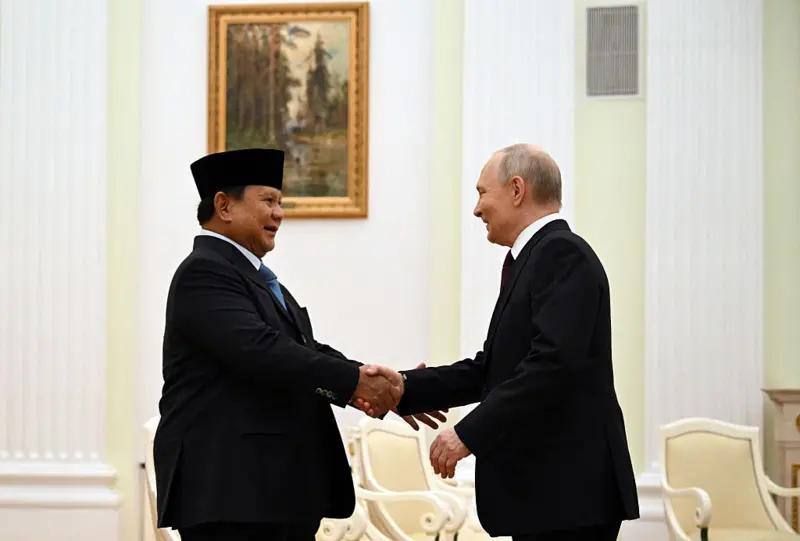
The government announced that it had secured opportunities for oil and gas supplies from Russia following a meeting between President Prabowo Subianto and President Vladimir Putin that lasted approximately three hours in Moscow.
During the meeting, the two leaders agreed to strengthen cooperation in the economic, energy, space, agricultural, industrial, and pharmaceutical sectors.
Minister of Energy and Mineral Resources Bahlil Lahadalia later confirmed that Indonesia has the opportunity to secure crude oil and natural gas reserves from Russia.
According to the government, this cooperation is crucial for maintaining national energy security amid global uncertainty.
The conflict between the United States and Israel against Iran is said to have an impact on global oil supplies.
Bahlil explained that exploratory discussions are being conducted through both government-to-government and company-to-company schemes.
In addition to oil and gas, Indonesia is also opening opportunities for collaboration in the fields of energy storage, minerals, and even nuclear energy.
Indonesia’s move to look toward Russia is considered reasonable, as the country is one of the world’s largest producers of oil and gas.
Following Indonesia’s accession to BRICS, opportunities for cooperation with Russia are also seen as increasingly open.
Indonesia’s interest in Russia is also driven by the situation in the Strait of Hormuz, which is disrupting oil distribution from the Middle East.
About 20 to 25 percent of Indonesia’s crude oil imports come from that region.
Therefore, the government needs to seek new sources of supply to reduce its dependence.
However, some observers have warned of risks, as Russia remains subject to sanctions from the European Union and Western countries due to the war in Ukraine.
If Indonesia openly purchases Russian oil, there is a possibility of trade pressure or secondary sanctions.
Additionally, questions arise regarding whether Russia can meet Indonesia’s needs, given that some of its energy facilities have been impacted by the war.
Analysts also note that the public is still awaiting tangible results from this latest agreement.