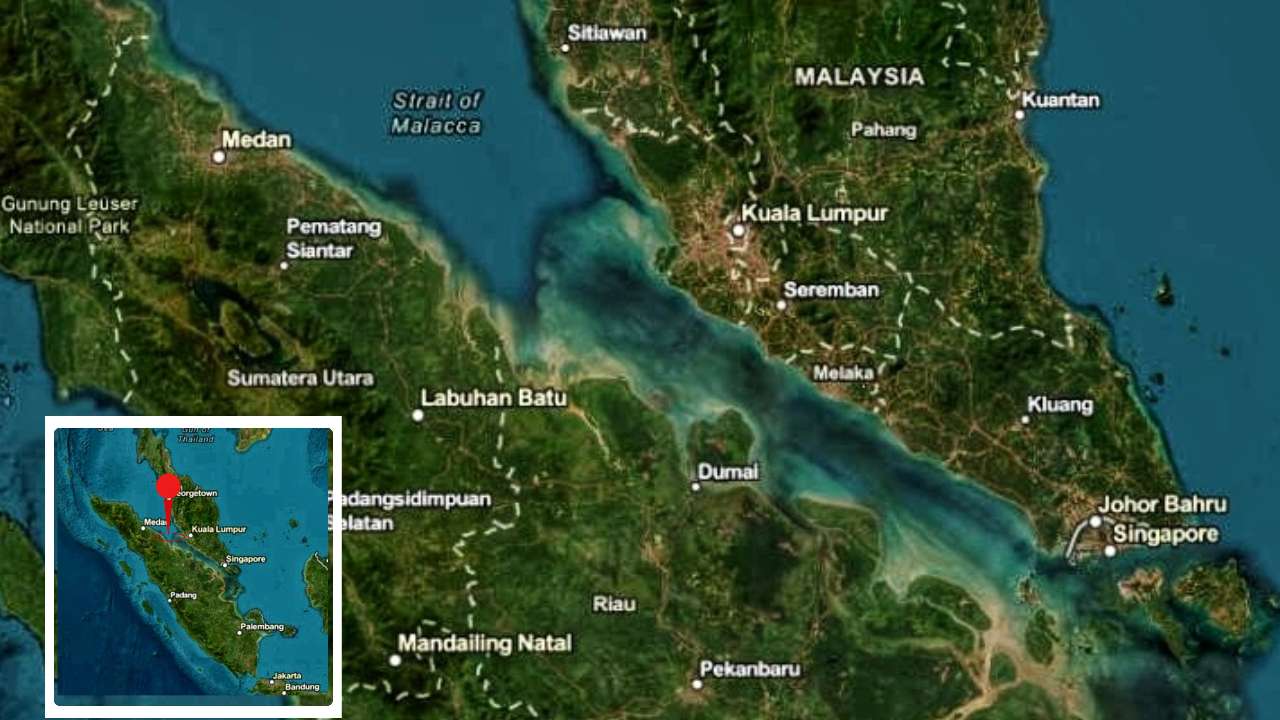
Amid the ongoing blockade of the Strait of Hormuz, the world’s attention has now shifted to another strategic waterway: the Strait of Malacca.
Interest has intensified after Indonesia confirmed that the United States has submitted a proposal to obtain full military access through Indonesian airspace.
The request came following the signing of a defense cooperation agreement between the two countries, while the Indonesian government stated that the proposal is still under discussion.
Observers believe this move has the potential to trigger far-reaching geopolitical repercussions in the region.
The Strait of Malacca is considered critically important as it serves as the fastest and most efficient shipping route connecting the Indian Ocean with the Pacific Ocean.
This route is the primary trade corridor linking the Middle East, Europe, and East Asia, and is directly connected to the South China Sea, through which approximately one-third of global trade passes.
At its narrowest point, near Singapore, the strait is only about 2.8 kilometers wide.
According to data from the U.S. Energy Information Administration, in the first half of 2025, approximately 23.2 million barrels of oil per day passed through the Malacca Strait.
That figure accounts for nearly 29 percent of global seaborne oil trade.
In addition, about 260 million cubic meters of liquefied natural gas per day also pass through this route.
The Strait of Malacca is also a vital route for the shipment of electronics, vehicles, industrial machinery, consumer goods, and bulk commodities.
Experts assess that the Malacca Strait plays an even more significant role than the Strait of Hormuz, as it is not only vital for energy but also a hub for the global distribution of various goods.
However, the region also faces security threats such as piracy and the risk of natural disasters.
Throughout 2025, 108 piracy incidents were recorded in the Malacca Strait and the Singapore Strait, the highest number since 2007.
From a geopolitical perspective, increasing competition between the United States, China, and India adds to the region’s sensitivity.
If the U.S. military presence increases in Indonesian airspace, China could interpret this move as heightened strategic surveillance near its vital shipping lanes.
While the likelihood of global trade being disrupted in the short term is low, long-term risks are considered more serious.
Tensions among major powers could push a region that was previously cooperative to become more competitive and militarized.
For China, the Malacca Strait holds special significance through the term “Malacca Dilemma,” which describes the country’s high dependence on this route.
Therefore, the Malacca Strait is expected to remain a focal point of global economic and geopolitical attention in the long term.