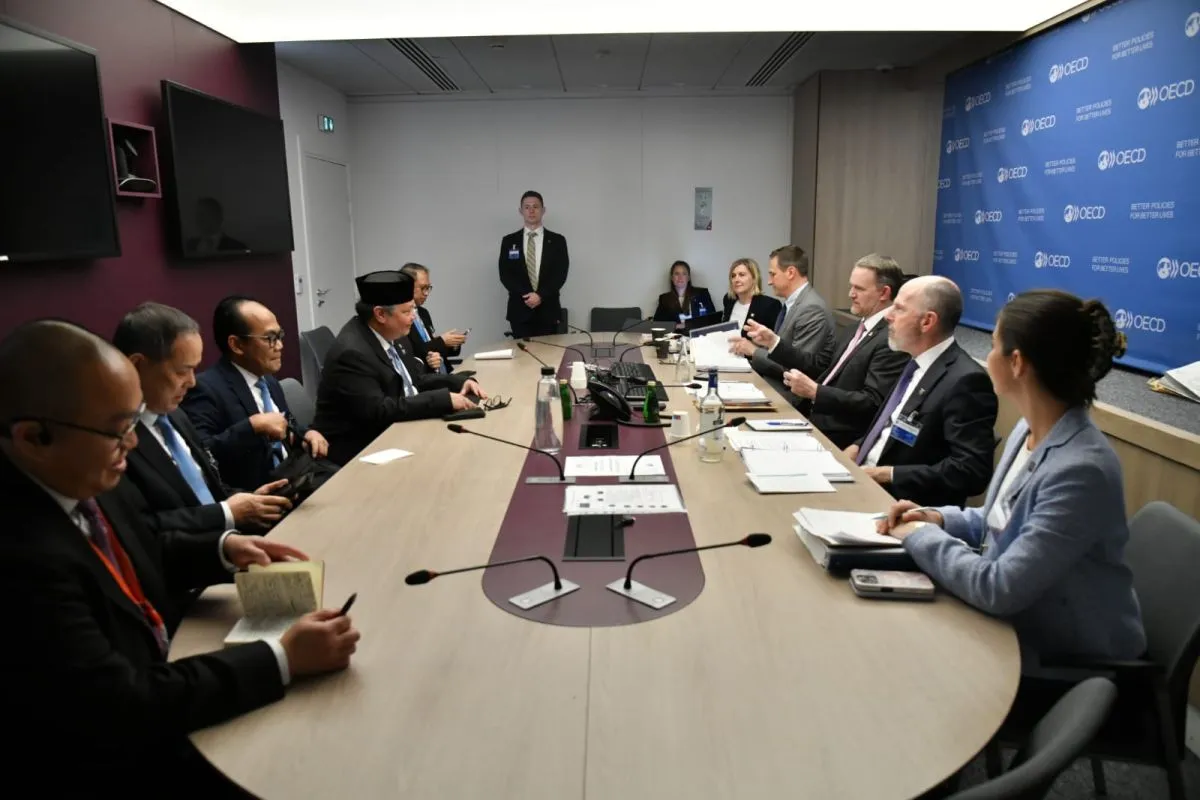
The Indonesian government stands a chance of securing approval for 18 tariff exemption requests submitted to the U.S. government through the Office of the U.S. Trade Representative (USTR).
This approval is expected to have a positive impact on the national industrial and trade sectors as it has the potential to lower export costs and enhance the competitiveness of Indonesian products in the U.S. market.
During a bilateral meeting held on the sidelines of the 2026 OECD Ministerial Meeting in Paris, Coordinating Minister for Economic Affairs Airlangga Hartarto expressed his appreciation to USTR Director General Jamieson Greer for the constructive communication throughout the tariff negotiation process.
According to Airlangga, the increasingly close cooperative relationship between Indonesia and the United States has helped achieve various advances in the discussion of trade issues of concern to both countries.
The U.S. government has also given a positive assessment of Indonesia’s efforts to strengthen labor law enforcement, particularly regarding the prevention of forced labor and oversight of trade supply chains.
As a result of these efforts, Indonesia has been included in the group of six priority countries receiving special attention, alongside Canada, Ecuador, the European Union, Mexico, and Pakistan.
Indonesia is also subject to an additional 10 percent tariff under U.S. trade policy, a rate lower than the 12.5 percent additional tariff applied to many other countries.
As part of its international trade commitments, the Indonesian government has issued regulations prohibiting the import of goods derived from forced labor practices.
Although the likelihood of securing a tariff exemption is quite high, implementation of the policy is expected to take place only after July 24, 2026, to avoid overlapping with currently applicable global tariff policies.
In addition to tariff issues, the two countries continue to discuss various trade barriers that still need to be resolved, including import licensing mechanisms and market access for certain agricultural commodities.
Indonesia is also continuing to seek an exemption from the Section 232 tariffs in effect in the United States for exports of copper cathodes produced by Freeport.
The government has reaffirmed its commitment to accelerating coordination across ministries and agencies to resolve various strategic trade issues and strengthen bilateral economic relations.
Through active and sustained economic diplomacy, Indonesia hopes to expand export market access, increase investment, and strengthen the country’s trade position in the global market.