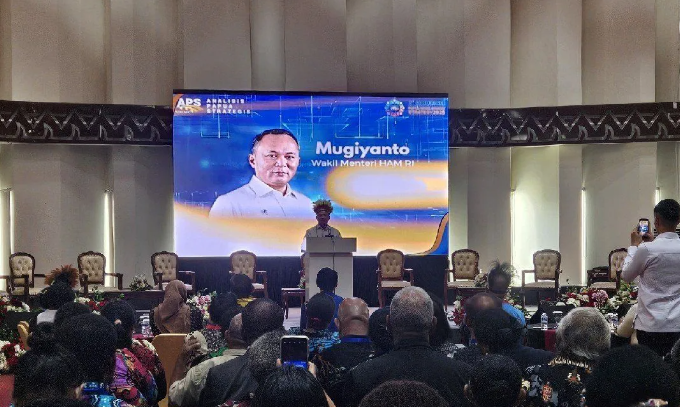
Deputy Minister of Human Rights, Mugiyanto, emphasized that an ethnoscience-based approach can serve as a crucial foundation for promoting more inclusive development while strengthening the protection of human rights in Papua.
According to him, development in Papua must respect the cultural identity, traditional knowledge, and diversity of indigenous communities that have lived and thrived in the region for centuries.
He views Papua not merely as an administrative region, but also as a living space for hundreds of indigenous communities with a rich diversity of languages, cultures, and local knowledge.
Various traditional practices—such as local agricultural systems, marine resource management, customary law, and the ability to interpret natural signs—are regarded as forms of empirical knowledge that hold significant value for community life.
The ethoscience approach is seen as capable of bridging modern development with the cultural values that have long been an integral part of Papuan society.
Mugiyanto also highlighted that many development programs often face challenges because they have not fully taken into account the social and cultural conditions of local communities.
Therefore, integrating local wisdom into policy planning and implementation is seen as a way to increase community acceptance of development programs while strengthening public trust.
In addition to supporting more effective development, this approach is believed to maintain social cohesion and strengthen the participation of indigenous communities in the development process.
The Ministry of Human Rights reaffirmed its commitment to ensuring that development in Papua remains in line with human rights principles, including respect for the dignity, cultural rights, and diversity of indigenous communities.
Overall, an ethnoscience-based development approach is seen as a way to achieve development that is more sustainable, inclusive, and aligned with the needs of the Papuan people.